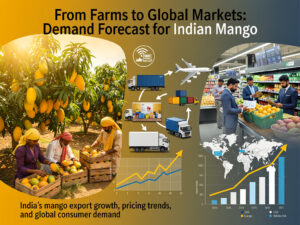
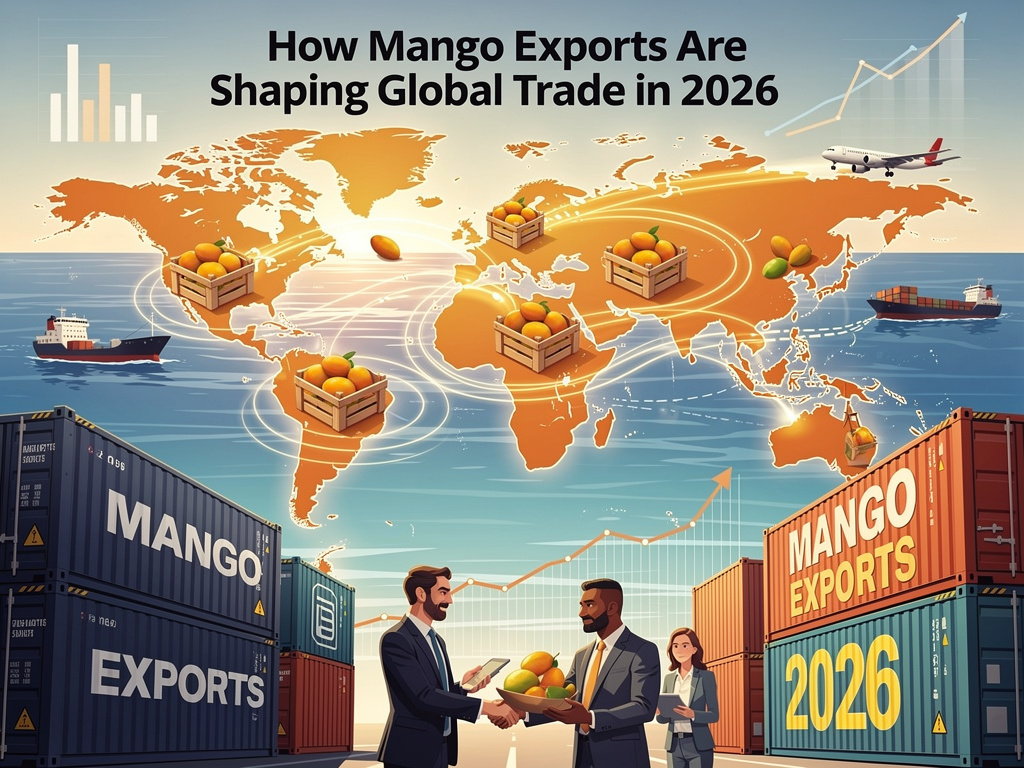
Mango exports are shaping global trade in 2026 by driving billions of dollars in agricultural commerce across more than 60 countries. The global fresh mango trade is valued at approximately USD 2.5 billion in 2026 and is growing every year. Countries like India, Mexico, Thailand, and Peru are at the centre of this trade, supplying mangoes to supermarkets, wholesale markets, and food manufacturers across Europe, North America, the Middle East, and Asia.
What makes mango trade especially significant in 2026 is the shift happening within it. It is no longer just about moving large volumes of fruit from one country to another. It is about quality, origin, branding, and the story behind the fruit. And no country understands this better than India.
At Kaybee Exports, we are proud to be part of India’s growing mango export story—connecting buyers around the world with the finest Indian mangoes sourced directly from certified orchards. Learn more at kaybeeexports.com.
The Global Mango Market in 2026: A Quick Picture
Before understanding how mango exports are shaping trade, it helps to understand the size of the market.
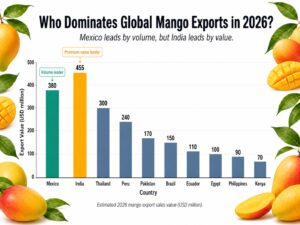
India produces over 40% of the world’s mangoes but is known more for quality than quantity in the export market. Mexico leads the world in mango export volume, shipping around 320,000 metric tons every year. Thailand, Peru, Pakistan, and Brazil are also major players.
But here is what matters most in 2026 — the countries that export the best quality mangoes are earning the most money per kilogram. India’s GI-tagged Alphonso mango sells for three to five times the price of a standard Tommy Atkins mango from Latin America. This tells you everything about where global mango trade is heading. Volume matters less and less. Quality, authenticity, and provenance matter more and more.
India Is Redefining What Premium Mango Means
India is the country doing the most to reshape how the world thinks about mangoes in 2026. For decades, mangoes were seen as a commodity—an affordable tropical fruit available in any supermarket. India is changing that perception entirely.
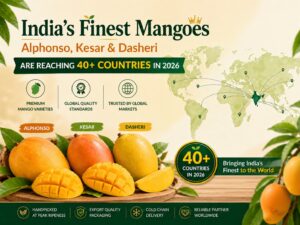
The Alphonso mango from Ratnagiri and Devgad in Maharashtra is now sold in premium British supermarkets at £4 to £8 per fruit. Kesar from the Gir region of Gujarat is stocked by specialist retailers in the UAE, the UK, and the USA who cater to buyers willing to pay more for something genuinely exceptional. These are not commodity mangoes. These are luxury food products with a protected origin, a centuries-old heritage, and a flavor that no other country in the world can replicate.
This repositioning of Indian mangoes from commodity fruit to premium food product is one of the most interesting things happening in global agricultural trade right now. And it is having a real impact on how buyers, retailers, and importers around the world think about sourcing mangoes.
Kaybee Exports works directly with the orchards that grow these exceptional varieties, making it easy for international buyers to access authentic Indian mangoes with full quality certification. Visit kaybeeexports.com to find out more.
How Mango Exports Are Creating New Trade Corridors
One of the most visible ways that mango exports are shaping global trade in 2026 is the creation of entirely new trade corridors that did not exist even five years ago.
India to Japan
Japan has one of the strongest premium fruit cultures in the world. Perfectly presented, gift-boxed fruit sells for extraordinary prices in Japanese department stores. Indian Alphonso mangoes are now entering this market in growing volumes, with a single mango retailing for USD 15 to 25. This is a brand new trade corridor built entirely on quality and provenance — exactly the kind of trade relationship that benefits Indian farmers and exporters most.
India to Australia
Australia has strict rules about what agricultural products can enter the country. For years, Indian mangoes could not access the Australian market easily. In 2026, more Indian mango varieties are being approved for import following irradiation treatment, opening a new Southern Hemisphere market for Indian exporters during the August to September season.
India to South Korea
South Korea is another frontier market that is importing Indian mangoes in growing quantities in 2026. Like Japan, it has a strong gifting culture around premium fruit, and Indian varieties are finding a receptive audience among Korean consumers who are always looking for new premium food experiences.
These new corridors are not just good for Indian exporters. They are reshaping global agricultural trade patterns and showing the world that the future of mango trade lies in quality-led, origin-branded products rather than bulk commodity shipments.
The Role of Branding and GI Tags in Global Mango Trade
One of the biggest shifts in global mango trade in 2026 is the growing importance of geographical indication tags and origin branding.
A GI tag works like a quality guarantee backed by law. When a buyer anywhere in the world sees a GI-tagged Alphonso from Ratnagiri or a GI-tagged Kesar from Gir, they know exactly what they are getting—authentic fruit from a specific region of India, grown under specific conditions, with a specific flavor profile that cannot be found anywhere else on earth.
This kind of branding is transforming Indian mangoes from agricultural exports into branded food products. It is the same principle that makes French Champagne worth ten times more than ordinary sparkling wine or Italian Parmigiano-Reggiano more valuable than generic Parmesan. Origin matters. Authenticity matters. And in 2026, the global mango market is finally catching up to this idea.
For international buyers, this means that sourcing GI-tagged Indian mangoes is not just about buying good fruit—it is about buying a product with a verifiable story that their own customers will pay a premium for.
Better Infrastructure Is Making Indian Mango Trade Possible at Scale
For all the talk of quality and branding, none of it matters if the mangoes do not arrive fresh. This is where infrastructure becomes critical—and where India has made enormous progress in 2026.
Cold storage facilities at orchard level in Maharashtra and Gujarat mean that fruit can be cooled within hours of picking, dramatically extending its shelf life. Refrigerated transport connects these orchards to certified pack houses and then to airports and seaports. Temperature-controlled sea freight containers are now being used for certain markets, which is reducing the cost of exporting Indian mangoes to Europe significantly.
This infrastructure investment is what is making Indian mango exports viable at scale for the first time. It is what allows a Kesar mango picked in Gir to arrive in perfect condition on a shelf in London or Dubai two weeks later.
Kaybee Exports sources mangoes through a network of certified pack houses with full cold chain support, ensuring the quality of every consignment is maintained from harvest to delivery. Get in touch at kaybeeexports.com/contact.
What This Means for International Buyers in 2026
If you are an importer, retailer, or food business looking to source mangoes in 2026, the message from global trade trends is clear. The demand for quality mangoes is growing. Consumers in the UK, USA, UAE, Japan, and Australia are actively seeking out authentic, origin-branded fruit—and they are willing to pay more for it.
India is the only country in the world that can supply GI-tagged premium mangoes like Alphonso and Kesar at export scale with full international quality certification. The window to build direct sourcing relationships with trusted Indian exporters is right now, before competition among international buyers intensifies further.
Kaybee Exports makes it simple for international buyers to source the best Indian mangoes directly. We supply fresh Alphonso, Kesar, Totapuri, Dasheri, Banganapalli, and Chaunsa to buyers across the Middle East, the UK, the USA, Europe, and Asia. Reach out to our team at kaybeeexports.com and we will come back to you quickly with everything you need.
Frequently Asked Questions
How are mango exports shaping global trade in 2026?
Mango exports are reshaping global trade in 2026 by shifting the focus from volume to quality and origin branding. Countries like India are creating new premium trade corridors to Japan, Australia, and South Korea, while GI-tagged varieties like Alphonso and Kesar are being repositioned as luxury food products commanding significantly higher prices than commodity mangoes.
Which country is leading mango exports in terms of quality in 2026?
India leads global mango exports in terms of quality and price realization in 2026. GI-tagged varieties, including Alphonso from Ratnagiri and Kesar from Gir, command the highest prices per kilogram of any mango variety exported anywhere in the world.
Which are the fastest-growing mango import markets in 2026?
The fastest growing markets for Indian mango imports in 2026 are the United States, Japan, South Korea, and Australia. All four markets are seeing year-on-year growth driven by diaspora demand and increasing mainstream consumer interest in premium Indian fruit.
How can I import Indian mangoes for my business?
Contact Kaybee Exports at kaybeeexports.com to source fresh, certified Indian mangoes directly. We supply premium varieties to buyers across the Middle East, UK, USA, Europe, and Asia with full quality certification and cold chain support.